When a business decides it needs a new website, one of the first questions usually sounds something like this:
Do we need a custom website, or can we just use a template?
There is no universal right answer.
A template can be a smart, efficient choice for one business and a frustrating limitation for another. A fully customized website can create significantly more flexibility—but paying for customization that the business does not actually need is not automatically a better investment.
The better question is:
What does your website need to accomplish for the business?
Once that is clear, the right approach becomes much easier to identify.
What Is a Website Template?
A website template provides a pre-designed foundation for the site.
That foundation may already determine things such as:
- Page layouts
- Navigation structure
- Typography
- Colours
- Blog layouts
- Buttons
- Spacing
- Headers and footers
Modern WordPress websites can be considerably more flexible than the word “template” suggests.
A strong theme can provide the underlying structure while allowing designers and developers to customize individual sections, templates, styles, and functionality.
That means using WordPress does not require accepting an off-the-shelf appearance.
The problem begins when the template dictates the business instead of supporting it.
When a Template Can Make Perfect Sense
Not every business needs a completely bespoke website.
Imagine a small company that needs five straightforward pages:
Home. About. Services. Contact. Blog.
The service offering is simple, the conversion path is clear, and the business does not need unusual functionality.
Starting with a strong framework may allow that company to launch faster and invest more of the budget into better copy, photography, SEO, or marketing.
Templates can make sense when:
- The website is relatively simple
- The budget is limited
- Speed to launch matters
- Required functionality is standard
- The business does not need unusual layouts
- The template can still be customized around the brand
The mistake is assuming that custom automatically means good or that template automatically means cheap and bad.
Execution matters more than the label.
Where Templates Start Creating Problems
Templates become restrictive when businesses start making compromises simply because the theme was not designed for what they need.
You may hear things like:
“We can’t put that section there.”
“The theme doesn’t support that.”
“We need another plugin for this.”
“That page has to use the same layout as everything else.”
At that point, the website is no longer being designed around the customer journey.
The business is being forced into the theme’s existing structure.
That can become especially frustrating as the company grows.
New services appear. Paid campaigns need dedicated landing pages. SEO requires more intentional site architecture. Conversion data suggests a page should be reorganized.
The website needs to evolve, but the template keeps fighting back.
If that sounds familiar, our guide on whether it is time to redesign your website can help determine whether targeted improvements are enough or whether the underlying structure has become the problem.
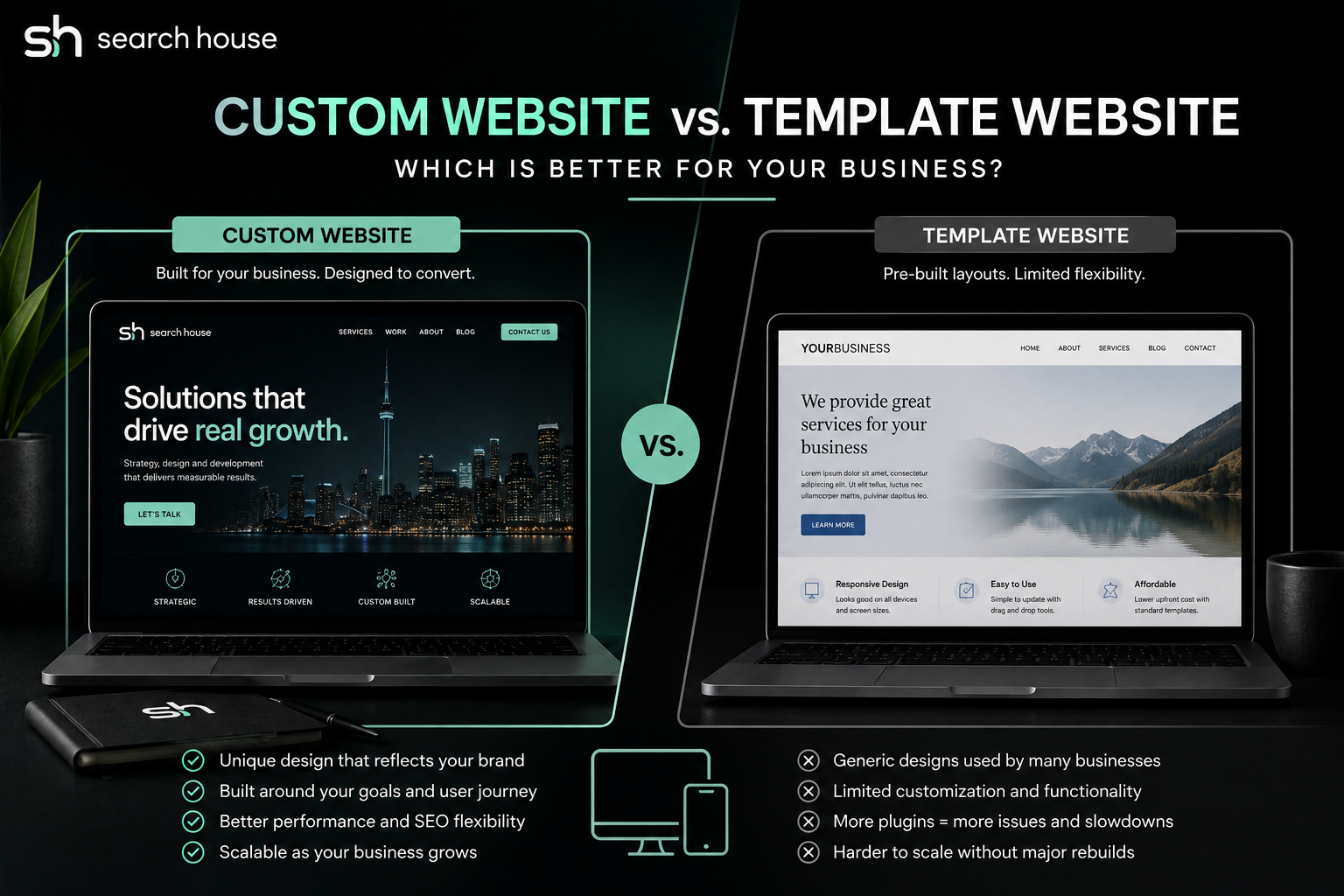
What Does “Custom Website” Actually Mean?
Custom does not necessarily mean building an entire content management system from scratch.
For most businesses, that would be unnecessary.
A better approach can be combining a proven platform with custom design and development.
That is how Search House approaches Website Design & Development.
WordPress provides the content-management foundation, while custom layouts, HTML, CSS, components, and styling allow the website to be shaped around the actual business.
You gain the advantages of an established platform without making the finished site look like a slightly modified theme demo.
That middle ground is often more practical than either extreme.
Customization Matters Most Where the Business Is Different
The strongest argument for custom design is not aesthetics.
It is specificity.
Your website should reflect how your customers actually make decisions.
A contractor may need prominent service areas, project galleries, financing information, and quote requests.
A B2B company may need deeper service pages, industry-specific content, resources, and longer conversion journeys.
A professional service business may need trust signals, credentials, FAQs, case studies, and consultation booking.
Those companies should not necessarily share the same page architecture simply because they purchased the same template.
Custom design allows the website structure to follow the business rather than forcing the business into predetermined boxes.
Think About SEO Before Choosing the Approach
Website design decisions can affect organic search long after the project launches.
Google needs to be able to discover important pages, understand the site structure, access the content, and render a usable mobile experience.
That is why SEO should be considered while the website is being planned—not added after the design is finished.
A site built for organic growth may need:
- Individual service pages
- Logical URL structures
- Strong internal linking
- Blog or resource architecture
- Location pages where appropriate
- Editable metadata
- Fast loading pages
- Mobile-friendly layouts
A template that handles those requirements cleanly may work perfectly well.
One that makes them difficult may become expensive to work around.
When structural or performance issues begin interfering with search visibility, Technical SEO and web development become closely connected.
Do Not Ignore the Cost of Plugins and Workarounds
A template may initially appear cheaper.
Then the workaround cycle begins.
One plugin handles the forms.
Another creates the layout you wanted.
Another adds custom fields.
Another controls the header.
Another handles performance problems created by everything else.
Eventually the “simple” website becomes a complicated stack of dependencies.
Plugins are not inherently bad. WordPress has an enormous ecosystem precisely because plugins make powerful functionality accessible.
But every addition should have a reason.
Sometimes writing a relatively small amount of custom code is cleaner than installing another large system simply to change one component.
That is one reason we favour intentional customization rather than piling functionality onto a site until it resembles the desired result.
So Which Should Your Business Choose?
Start with the requirements.
Choose a template-led approach when the business has relatively standard needs and the framework already supports the experience you want to create.
Choose a more customized approach when:
- Your services require a specific customer journey
- SEO is an important growth channel
- You need unique landing pages
- Brand differentiation matters
- Existing themes create structural compromises
- The site needs room to evolve
- Standard layouts do not communicate the business effectively
And sometimes the best answer is a hybrid:
Use a strong WordPress foundation, then customize the parts that actually matter.
That gives the business flexibility without rebuilding technology that already works.
Build the Website Around the Business
Customers do not care whether your website began with a theme, a blank canvas, or a collection of custom blocks.
They care whether it works.
Can they understand what you offer?
Can they find the information they need?
Does the company feel credible?
Does the site work properly on their phone?
Can they take the next step easily?
Those are the outcomes that matter.
Search House builds websites around search visibility, customer journeys, brand positioning, and conversion—not around forcing every client into the same predefined layout.
A good website should feel like it belongs to the business it represents.
If the framework helps accomplish that, use it.
If the framework gets in the way, customize it.