A website does not need to look broken to be costing your business opportunities.
It can load. It can have your services listed. It can even look reasonably modern.
And it can still be working against you.
That is what makes the decision to redesign difficult for business owners. An obviously outdated website is easy to identify. A website that looks “fine” but quietly creates friction is much harder to diagnose.
The right question is not:
“Is our website old?”
It is:
“Is our website still helping the business compete?”
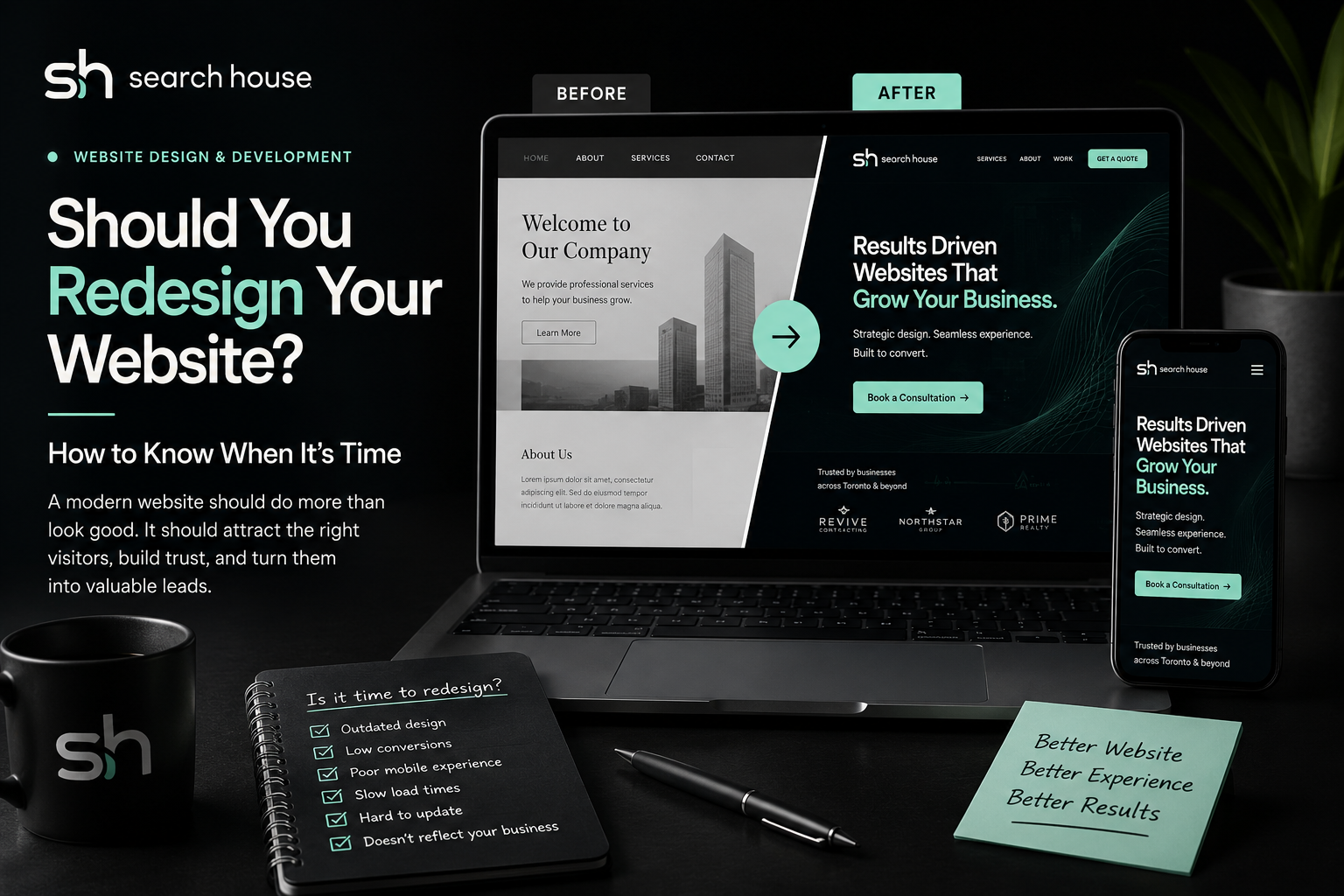
A redesign should solve business problems—not simply replace one visual style with another.
Start With What the Website Is Supposed to Do
Before considering colours, layouts, animations or platforms, define the website’s job.
For many service businesses, that means helping potential customers:
- Understand what the company offers
- Determine whether the service fits their needs
- Trust the business
- Find relevant information
- Contact the company
If those things happen easily, an older website may still be doing its job.
If visitors regularly reach the website but rarely inquire, the issue becomes more interesting.
Search House approaches Website Design & Development from that perspective. The website is not simply a digital brochure. It is part of the path between someone discovering your business and deciding to contact it.
A Redesign Makes Sense When Your Business Has Outgrown the Website
Businesses change faster than websites sometimes do.
You may have launched with three services and now offer ten. You may have expanded from one location into several markets. Perhaps your ideal customer has changed completely.
But the website still represents the company from three years ago.
This creates a strategic mismatch.
A prospective customer might see outdated services, vague positioning or a navigation structure built around a business that no longer exists.
At that point, redesigning is not about appearance.
It is about making the website accurately represent what the company has become.
Your Website Should Make the Business Easy to Understand
Some websites create confusion within seconds.
The homepage may open with a clever slogan but never clearly explain what the company actually does.
Services are buried.
Important information is spread across unrelated pages.
Calls to action compete with one another.
The visitor has to work to understand the offer.
That is dangerous because people arriving from search often have a specific goal already in mind.
A person searching for a particular service should be able to move quickly from:
Search → Relevant Page → Understanding → Action
This is also why website structure and SEO are closely connected.
A good website gives important services their own clear place instead of forcing every type of visitor through one generic homepage.
Traffic Without Leads Is a Website Signal
If your website receives almost no traffic, redesigning it may not solve the fundamental problem.
You might need stronger SEO, advertising or another acquisition strategy.
But if people are arriving and very few become leads, the website deserves scrutiny.
Look at what happens after the visit begins.
Are visitors reaching service pages?
Are they interacting with forms?
Are mobile users leaving faster?
Are paid campaigns sending traffic that never converts?
As we discussed in our article on why Google Ads aren’t converting, paid media problems do not always exist inside the advertising account.
Sometimes the campaign successfully brings in the right visitor and the website loses them afterward.
That distinction matters.
Spending more money to drive traffic into a poor conversion experience does not solve the problem.
It magnifies it.
Mobile Should Not Feel Like a Smaller Desktop Site
One of the strongest reasons to revisit an older website is a weak mobile experience.
Responsive design is more than making elements fit onto a smaller screen.
Mobile visitors behave differently.
Navigation needs to be simpler. Buttons need enough room to tap. Forms need to be manageable. Important information needs to appear quickly.
Google recommends focusing on simple navigation, load speed and making important customer actions easy to complete on mobile.
If your desktop website looks polished but using it on a phone feels frustrating, the site is not truly performing well.
And that matters whether visitors arrive through SEO, Google Ads, referrals or direct traffic.
Performance Problems Can Become Design Problems
Modern websites often accumulate baggage.
Another plugin gets installed.
A new tracking script gets added.
Images are uploaded without optimization.
Animations become heavier.
Years later, the site still functions—but everything feels slower.
Google specifically recommends improving landing-page speed and highlights mobile performance as an important part of the user experience.
This does not mean every slow website requires a full redesign.
Sometimes optimization is enough.
But when performance problems are tied to an old theme, bloated builder, outdated architecture or years of accumulated technical compromises, rebuilding may be cleaner than continually patching the old foundation.
Be Careful With Redesigns That Ignore SEO
There is also a wrong way to redesign a website.
A company launches something visually impressive and then discovers that important URLs changed, internal links disappeared, page content was removed or search visibility declined.
That is why SEO should be considered during the redesign—not after launch.
If an existing site already generates organic visibility, the new website needs to preserve what is working while improving what is not.
That can mean reviewing:
- Existing rankings
- Valuable landing pages
- URL structure
- Redirect requirements
- Internal links
- Metadata
- Content
- Crawlability
Our Technical SEO work considers these elements because a prettier website is not an improvement if customers can no longer find it.
Sometimes You Do Not Need a Full Redesign
This is equally important.
Not every website needs to be rebuilt.
If the foundation is strong, targeted changes may produce a better return.
That could mean improving the homepage messaging, rebuilding a few service pages, simplifying navigation, improving forms or making the mobile experience stronger.
A redesign becomes worthwhile when the limitations are structural enough that fixing them individually creates more complexity than replacing the underlying system.
The goal should never be to sell a rebuild because “your website is old.”
The goal is to determine whether the current website can still support where the business is going.
The Best Website Is the One That Helps the Business Move Forward
A successful redesign should leave the business with more than a different-looking homepage.
It should create clearer positioning.
Better service architecture.
Stronger mobile usability.
Faster paths to conversion.
A stronger foundation for SEO and paid media.
And a website that actually feels representative of the company customers are hiring today.
That is how Search House approaches website projects.
We build WordPress websites with search visibility, messaging, usability and conversion in mind because those elements eventually have to work together.
If your current website still supports the business effectively, keep improving it.
If the business has outgrown it, customers struggle to use it, or marketing keeps sending traffic into an experience that no longer performs, then a redesign may be less of a cosmetic project—and more of a growth decision.