Running Google Ads should feel simple in theory.
You pay for visibility, potential customers click, leads come in, and the business grows.
But for many business owners, the reality looks very different. Spend goes out every month, clicks appear in the account, and yet the actual results feel weak, inconsistent or difficult to explain.
That often leads to one of two conclusions:
“Google Ads doesn’t work for my business.”
or
“We just need to spend more.”
Usually, neither is the real problem.
When Google Ads underperform, the issue is often somewhere inside the relationship between tracking, targeting, messaging, campaign structure and the experience people have after they click.
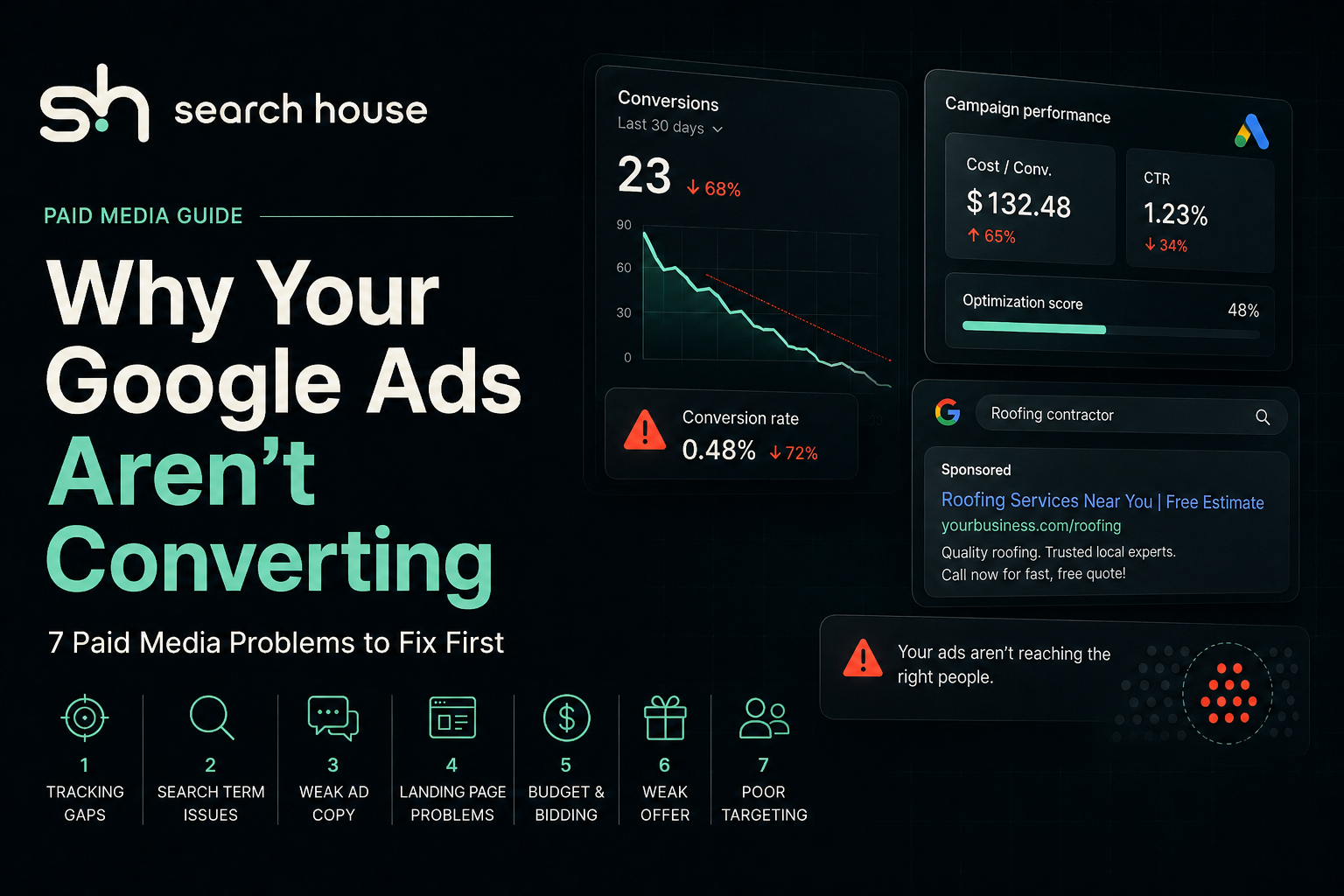
Here are seven areas we would investigate first.
1. You’re Measuring Clicks Instead of Business Outcomes
The first question should be simple:
What does a valuable conversion actually look like for your business?
For one company, it may be a phone call. For another, a form submission, booked consultation, quote request or ecommerce purchase.
If tracking is incomplete or configured around the wrong actions, the campaign can appear healthy while generating little business value.
That makes it difficult to answer:
- Which campaign generates qualified leads?
- Which keyword produces revenue?
- Which ads attract valuable customers?
- What should Google actually optimize toward?
This is why Conversion Tracking & Analytics should be treated as part of the campaign foundation rather than an afterthought.
If the data going into the account is unreliable, optimization becomes guesswork.
2. You’re Targeting the Wrong Search Intent
Not every click is worth buying.
A campaign can generate plenty of traffic while failing because the people clicking are researching casually, looking for something different or sitting too early in the buying journey.
This often happens when keyword targeting becomes disconnected from customer intent.
For many service businesses, searches containing terms such as these can signal stronger commercial intent:
- service
- company
- agency
- quote
- pricing
- near me
- install
- repair
- consultant
The exact terms depend on the business.
The principle does not.
The objective of Google Ads Management should not be to buy as much traffic as possible.
It should be to capture the right demand at the right moment.
3. Your Search Terms Are Wasting Budget
Keywords are not always the same thing as the searches people actually type.
That difference can become expensive.
The search terms report shows the real queries that triggered your ads. Reviewing it can reveal irrelevant searches, weak intent and opportunities for negative keywords.
For example, you may believe you are targeting someone looking to hire your business while the campaign is actually spending money on searches related to jobs, free information, DIY solutions or services you do not provide.
That waste can quietly accumulate for months.
A good paid search account should regularly review:
- Actual search queries
- Irrelevant matches
- Negative keyword opportunities
- Search intent
- Themes that do not belong in the campaign
When we conduct PPC Audits, this is one of the places where inefficient spend can become visible quickly.
4. Your Ads Aren’t Specific Enough
Weak ads often sound like every other business in the market.
Think:
Quality service. Trusted experts. Contact us today.
Those statements may be true, but they give the searcher very little reason to choose one advertiser over another.
Strong ad messaging creates a much tighter relationship between:
Search → Ad → Offer → Landing Page
If someone searches for a specific service, the advertisement should clearly reflect that service.
If your competitive advantage is speed, local expertise, specialization, transparent pricing or another meaningful benefit, the messaging should make that clear.
Generic advertising creates generic results.
5. Your Landing Page Is Losing the Lead
Getting the click is only half the job.
Once someone reaches the website, the landing page has to continue the conversation that the advertisement started.
A strong page should quickly answer:
- Am I in the right place?
- Does this company offer what I searched for?
- Why should I trust them?
- What should I do next?
Common problems include:
- Sending paid traffic to a generic homepage
- Weak calls to action
- Slow pages
- Poor mobile layouts
- Missing trust signals
- Too much friction in forms
- Ad messaging that does not match the page
Our approach to Landing Page Optimization focuses on that complete conversion path.
Buying a click does not create value.
What happens after the click does.
6. Your Budget and Bidding Strategy Don’t Match the Market
Sometimes the campaign is targeting the right people but the structure itself makes efficient performance difficult.
We commonly see businesses spread limited budgets across too many campaigns, make constant changes or use automated bidding before reliable conversion data exists.
Other issues can include:
- Unrealistic cost-per-lead expectations
- Campaigns competing against one another
- Insufficient budget for competitive searches
- Too many services grouped together
- Constant changes preventing useful performance data from accumulating
Automation can be powerful, but it still needs good inputs and a sensible strategy.
A bidding system cannot fix a weak offer, broken tracking or irrelevant traffic.
7. The Offer Simply Isn’t Strong Enough
This is the problem advertisers sometimes least want to hear.
The campaign may be technically sound, but competitors are presenting a more compelling reason to choose them.
Paid advertising exposes positioning quickly because every visitor costs money.
If potential customers click and consistently leave, investigate the offer itself.
Ask:
- Is the service clearly differentiated?
- Is the value proposition obvious?
- Does the page build trust?
- Is the call to action reasonable?
- Are competitors offering something easier or more compelling?
Paid media does not magically create demand for a weak proposition.
It amplifies what the business already presents.
What Should You Fix First?
If your Google Ads are generating clicks without enough qualified leads, diagnose the campaign in this order:
- Tracking — Are valuable conversions being measured correctly?
- Intent — Are you attracting people who actually need the service?
- Search terms — What are you really paying for?
- Messaging — Does the ad clearly address the search?
- Landing page — Is the post-click experience converting demand?
- Budget and bidding — Does the structure match the market?
- Offer — Is there a strong enough reason to choose your business?
That sequence matters.
Increasing the budget before fixing broken tracking simply allows bad decisions to happen faster.
Better Paid Media Starts With Better Diagnosis
When Google Ads underperform, the solution usually is not to blindly spend more.
The real issue is often somewhere between the search that triggered the ad and the business outcome you expected from it.
Search House approaches Paid Media Management as a complete acquisition system rather than a collection of campaign settings.
That means looking at the search terms, tracking, ads, landing pages, budget, customer intent and commercial goals together.
If your campaigns are generating clicks but not enough qualified leads, the next step should not be another round of guesswork.
It should be finding the constraint — and fixing what is actually preventing the campaign from turning paid traffic into business.