If you only have enough budget to take one paid channel seriously, choosing between Google Ads and Meta Ads can feel like a platform decision.
It is not.
It is a demand decision.
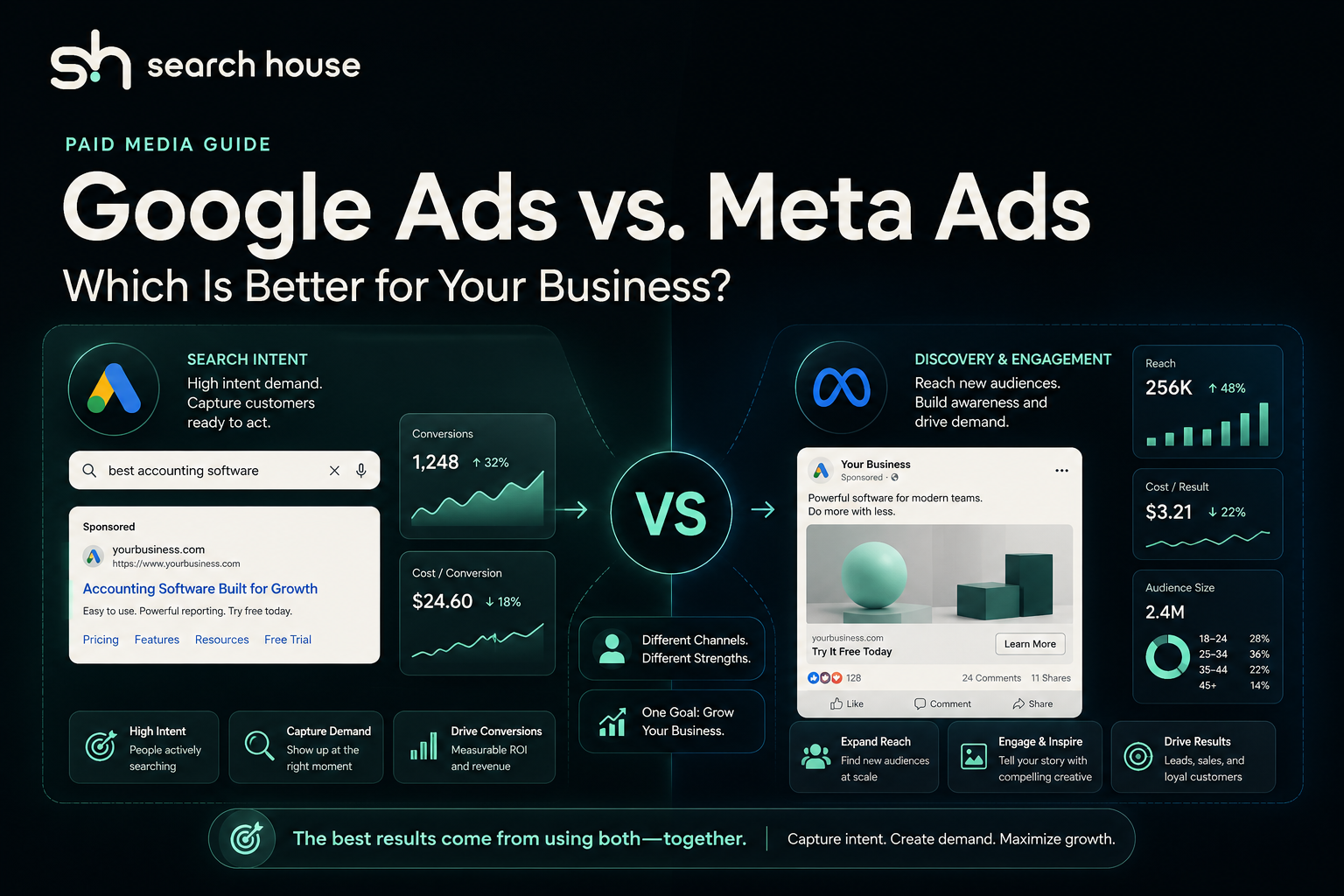
Both platforms can generate leads and sales, but they meet customers in different moments. Google is strongest when somebody is already expressing a need through search. Meta is strongest when the right person can be reached before they actively start looking.
Start With the Customer’s Moment, Not the Platform
Imagine two people.
The first searches “emergency plumber near me.” Their problem already exists. They know what they need and are comparing options.
The second is scrolling Instagram and sees a compelling ad for a service they had never seriously researched. The advertisement creates interest before a search happens.
Google Ads is useful when customers reveal intent through the words they search. Search House’s Google Ads Management work is built around capturing that existing demand and turning it into a relevant next step.
Meta Ads can operate earlier. Facebook and Instagram can introduce a product, service or problem to people who fit the audience even when they were not planning to search that day.
Our Meta Ads Management approach therefore puts more emphasis on audience context, creative, offer clarity and repeated exposure.
When Google Ads Usually Deserves Priority
Google often deserves the first portion of budget when people already know how to search for what you sell.
Examples include:
- Urgent home services
- Lawyers, accountants and other professional services
- Established product categories
- B2B solutions with recognizable search demand
- Local services where “near me,” “quote,” or service-specific searches signal intent
The advantage is timing.
You are not trying to convince someone that a problem exists. You are trying to become a credible option while they are already evaluating solutions.
But search intent alone does not guarantee performance.
Search terms can drift. Clicks can become expensive. Weak conversion tracking can optimize toward the wrong actions. A generic homepage can waste strong intent.
That is why Google Ads should be treated as a complete customer path rather than a keyword auction.
If the account is already generating traffic without enough leads, our guide to why Google Ads aren’t converting is a better place to diagnose the problem before simply increasing spend.
When Meta Ads Can Be the Better Starting Point
Meta becomes especially interesting when the audience is easier to identify than the search.
That can include visually compelling services, new offers, ecommerce products, promotions and businesses with strong video or image creative.
A potential customer does not need to type the perfect keyword first.
The ad itself can create the moment of consideration.
A Google Search ad can respond to an explicit request. A Meta ad may need to earn attention, establish relevance, explain the value and create enough curiosity for someone to leave the feed.
A weak Meta campaign is therefore not always a targeting problem.
Sometimes the creative simply did not earn the next step.
The Landing Page Should Match How the Visitor Arrived
One of the biggest mistakes is sending Google and Meta traffic into exactly the same experience.
Someone arriving from Google may already understand the problem and want proof, availability or a direct way to contact the business.
Someone arriving from Meta may need more explanation first.
That is why our Landing Page Optimization work considers the campaign that generated the visit.
For high-intent Google traffic, a focused service page with a clear call, form or booking path may be appropriate.
For Meta traffic, the page may need to establish the problem, introduce the offer, build confidence and then ask for a proportionate next step.
The traffic source changes the visitor’s level of awareness.
The page should respect that.
Sometimes the Best Answer Is Both
Google and Meta do not have to perform the same job.
A customer might discover a business through Instagram, visit the website, leave, search the brand days later and eventually convert through Google.
Another may first arrive from paid search and later respond to a Meta remarketing campaign.
This is why Search House approaches Paid Media Management as a connected system rather than two unrelated dashboards.
A combined journey could look like:
Meta creates awareness → the customer researches → Google captures later intent → remarketing supports the decision → the customer converts.
Whether that sequence makes financial sense depends on customer value, budget, sales cycle and available demand.
Budget matters too. If you’re unsure whether your proposed Google spend is capable of producing useful data in the first place, start with our guide to how much you should spend on Google Ads.
Do Not Scale Either Platform Without Useful Measurement
There is one situation where neither platform deserves more budget:
The business cannot tell what a valuable conversion is.
Platforms optimize toward the signals they receive.
If low-quality form submissions and qualified opportunities are treated as equally valuable, campaign automation can become very efficient at producing the wrong outcome.
Conversion Tracking & Analytics should help answer more than:
“Did somebody convert?”
Whenever possible, the business should understand whether those actions become qualified leads, bookings, purchases or legitimate pipeline opportunities.
If an existing account is spending without a clear explanation of where performance is breaking down, a PPC Audit may be more useful than immediately switching channels.
A Practical Decision Framework
Choose Google Ads first when people are already searching for what you sell and those searches demonstrate meaningful commercial intent.
Choose Meta Ads first when the audience can be identified, the offer benefits from discovery or visual explanation, and interest needs to be created before customers search.
Consider both when the buying journey includes discovery, research and multiple interactions before conversion.
Pause either platform when tracking, landing pages or the offer itself are not ready for more traffic.
The Better Platform Is the One With a Clear Job
Google Ads is not automatically better because search intent is strong.
Meta Ads is not automatically better because it can reach large audiences.
The better platform is the one whose role matches how your customers actually move toward a decision.
Start with the buying journey.
Decide whether you need to capture demand, create demand or do both.
Then build the campaign, landing page and measurement around that job.
That is much more useful than asking which advertising platform wins in general.