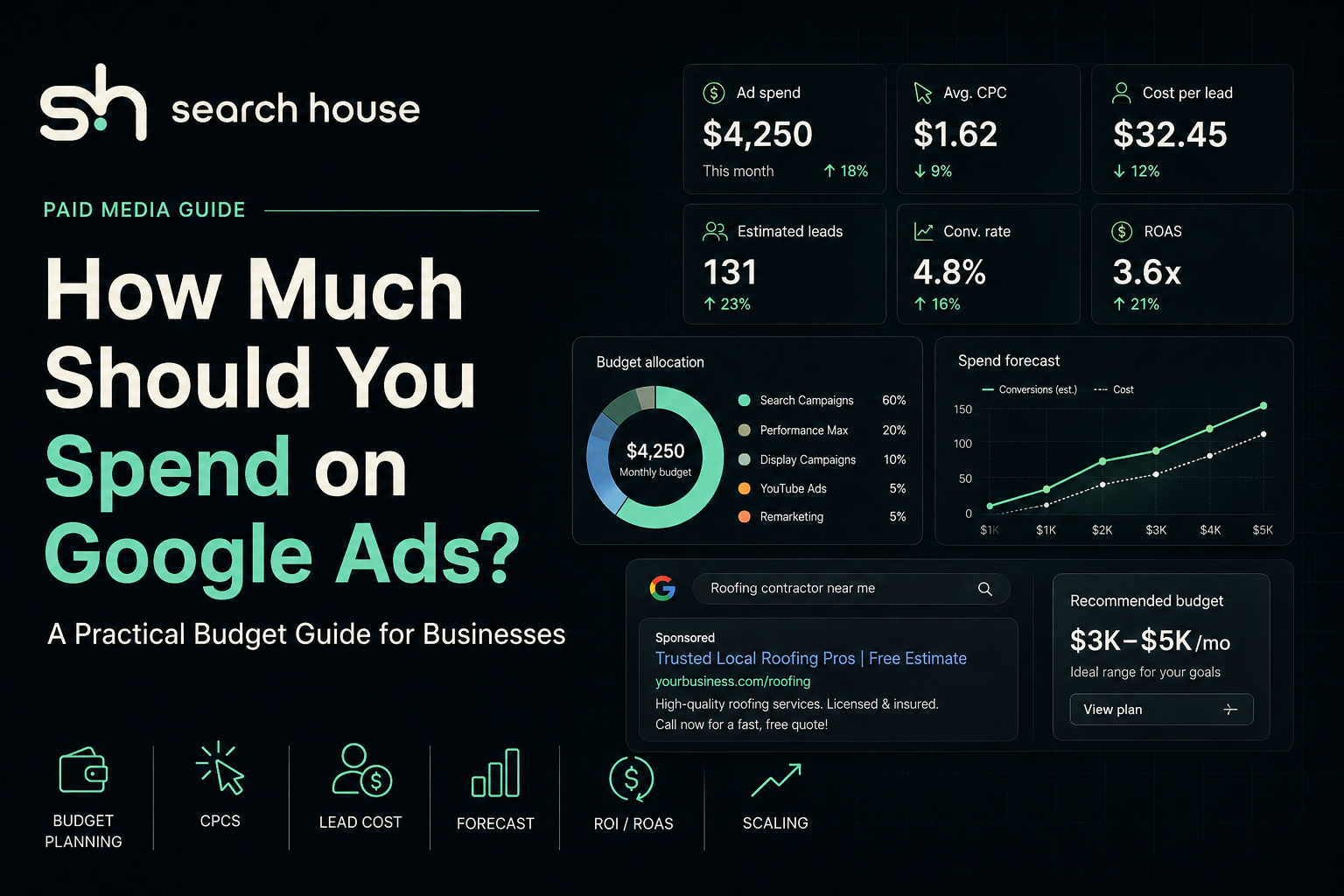
“How much should I spend on Google Ads?” sounds like a simple question.
It is also one of the easiest questions to answer badly.
A $1,000 monthly budget may be plenty for one business and almost meaningless for another. The right number depends on click costs, how often clicks become qualified leads, customer value, and how much demand actually exists.
That means a useful Google Ads budget should not begin with an arbitrary number. It should begin with the economics of the business.
Here is how we think about paid search budgets at Search House.
1. Start With the Value of a Customer
Before deciding what Google should be allowed to spend, determine what a new customer is actually worth.
A business selling a $75 product has very different economics from a commercial contractor where one new project may be worth tens of thousands of dollars.
For lead-generation businesses, useful questions include:
- What is the average value of a new customer?
- What percentage of leads become customers?
- What gross margin does the business keep?
- How much can you reasonably afford to pay for a qualified lead?
This gives you something more useful than a generic “recommended budget”: a target acquisition cost that makes sense for the business.
Budget should follow unit economics.
2. Estimate the Cost of Capturing Search Demand
Next, look at the market you are entering.
Google Ads is an auction, so costs vary by keyword, geography and competition.
This is where keyword and market research matter.
Google Keyword Planner can provide estimates around search demand, clicks and expected spend. Those forecasts are not guarantees, but they can show whether a proposed budget can generate enough traffic to learn from.
Our Google Ads Management approach starts with this kind of demand analysis rather than choosing a budget in isolation.
If commercially valuable searches are expensive, a very small daily budget may simply be too thin to generate enough useful data.
3. Work Backward From the Leads You Need
Instead of asking:
“What is the minimum I can spend?”
ask:
“How many qualified opportunities do we need this channel to create?”
If the business needs 20 additional leads per month and the realistic cost per qualified lead is around $100, the media budget required is roughly $2,000.
That is a planning model, not a promise. Costs and conversion rates fluctuate.
But working backward from the business target forces the budget conversation to focus on outcomes instead of arbitrary limits.
It also exposes unrealistic expectations early.
4. Do Not Spread a Small Budget Across Everything
One of the fastest ways to make a modest budget ineffective is to divide it across too many services, locations and campaigns.
Trying to advertise every service in every location at once often creates tiny budgets that never collect enough meaningful data.
Focus is usually better.
Start with:
- The most profitable service
- The strongest geographic market
- The clearest commercial-intent searches
- The landing page most likely to convert
Then expand after you understand performance.
If an account already feels fragmented, a PPC Audit can help identify where spend is being diluted across campaigns that do not deserve equal priority.
5. Budget for Testing, Not Just Immediate Leads
Paid search is measurable, but campaigns rarely start perfectly.
Early performance should help answer questions such as:
- Which search terms actually convert?
- Which ads attract the right customers?
- Which locations produce stronger leads?
- Which landing pages create friction?
That learning has value.
A budget that only works if every early click turns into an efficient lead is usually too fragile.
Expect an initial period where the campaign gathers enough information to support better decisions.
This is also why making major changes every day can make performance harder to interpret.
6. Make Sure Tracking Is Ready Before You Increase Spend
Scaling without trustworthy measurement is one of the easiest ways to waste money.
Before increasing the budget, confirm that Conversion Tracking & Analytics is measuring the actions that genuinely matter.
For a lead-generation business, a form submission is useful. Knowing which leads become qualified opportunities is even better.
For ecommerce, revenue and conversion value provide more context than conversion count alone.
If the campaign cannot distinguish valuable customer actions from low-value ones, increasing spend may simply create more of the wrong result.
Better data improves budgeting.
7. Know When More Budget Actually Makes Sense
More spend becomes useful when the campaign has shown that additional demand can be captured at an acceptable cost.
Positive signals can include:
- Campaigns regularly limited by budget
- Cost per lead remaining sustainable
- Strong lead quality
- Landing pages converting consistently
- Relevant search terms
- Additional search demand available
At that point, increasing budget can become a growth decision rather than a gamble.
But if your Google Ads are generating clicks without converting, increasing spend will usually magnify the underlying problem rather than solve it.
So, What Is a Good Starting Google Ads Budget?
There is no universal minimum that works for every business.
A useful starting budget is one that can buy enough relevant traffic to evaluate the campaign without putting the business under financial pressure.
For some local businesses, that may mean testing one focused service in one market before expanding. Competitive industries may require considerably more.
The important part is that the budget connects three things:
Search demand → expected acquisition cost → business value
If those numbers do not make sense together, the campaign needs a different strategy.
Build the Budget Around the Business, Not the Platform
Google Ads should not decide what your business can afford.
Your economics should determine what Google Ads needs to achieve.
Start with customer value. Estimate the cost of reaching relevant demand. Work backward from the leads or sales you need. Then structure the account so the available budget is concentrated where it has the strongest chance of producing a return.
Search House approaches Paid Media Management this way because “spend more” is not a strategy.
A strong paid search budget gives the campaign enough room to learn, enough focus to produce useful data, and a clear financial threshold for deciding whether the investment is actually working.
If you are unsure whether your current Google Ads budget is too low, too high or simply allocated poorly, the first step is understanding what each dollar is expected to accomplish.