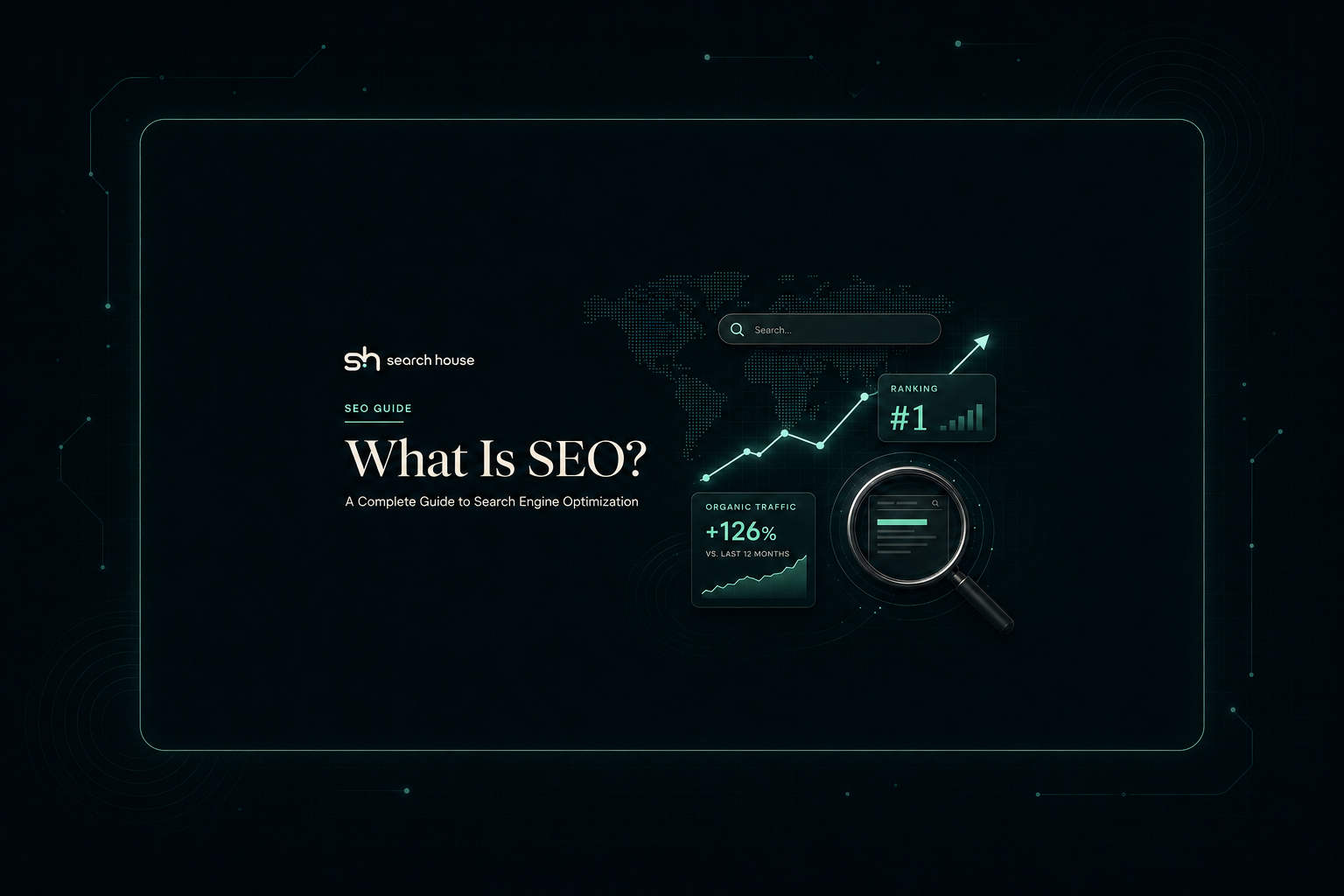
Search engine optimization, better known as SEO, is the process of improving a website so that the right people can find it when they search online.
That sounds simple. In practice, SEO sits at the intersection of your website, your content, your brand, your technical infrastructure and the way people actually search for information.
Good SEO isn’t about stuffing keywords into pages or trying to trick an algorithm.
It is about making your website easier to discover, easier to understand and more useful than the alternatives.
For a business, that means showing up when potential customers are actively looking for the products, services or expertise you provide — without paying for every individual click.
This guide breaks down how SEO works, what actually matters, where different types of SEO fit together and how businesses can build organic visibility that compounds over time.
What Does SEO Mean?
SEO stands for Search Engine Optimization.
It describes the work done to improve a website’s visibility in unpaid, or organic, search results.
Imagine someone searches:
- “commercial plumber Toronto”
- “best CRM for construction companies”
- “how to fix a leaking basement”
- “SEO company near me”
- “technical SEO audit”
- “what is local SEO?”
Search engines need to decide which websites, businesses, articles, videos and other resources are most useful for each search.
SEO helps search engines understand what your website is about while simultaneously making the website more useful to the people performing those searches.
The second half of that sentence matters.
Modern SEO is not simply about making a website understandable to Google. A technically perfect website with weak content, poor usability and nothing genuinely useful to say is unlikely to become a strong organic search asset.
The goal is to satisfy both sides:
Make your website easy for search engines to discover and understand — and worth visiting for the people those search engines send to it.
How Does SEO Work?
Search engines perform an enormous amount of work between discovering a webpage and deciding whether it should appear for a particular search.
You can simplify the process into three broad stages:
1. Crawling
Search engines use automated programs commonly called crawlers or bots to discover webpages.
They find pages through links, XML sitemaps and previously discovered URLs.
If an important page cannot be crawled properly, everything else you do to optimize it may be irrelevant.
2. Indexing
After discovering a page, the search engine attempts to understand it.
It may analyze elements including:
- The main content
- Page headings
- Titles
- Internal and external links
- Images
- Structured data
- Relationships between pages
- The overall subject of the website
Eligible pages can then be stored within the search engine’s index.
Being indexed does not guarantee that a page will rank prominently. It simply means the page can potentially be considered for relevant searches.
3. Ranking and Retrieval
When someone searches, the search engine tries to return the information it believes will be most useful for that particular query.
There isn’t one universal ranking formula that applies identically to every search.
A person searching for a nearby emergency plumber has very different needs from someone researching accounting software or learning how mortgages work.
The search engine therefore has to understand both:
What is the searcher trying to accomplish?
and
Which available results are most likely to help them accomplish it?
That is why effective SEO goes far beyond individual keywords.
The Search House View of SEO
A useful way to understand SEO is through five connected ideas:
Discovery → Relevance → Trust → Experience → Conversion
Discovery
Can search engines reliably find, crawl and access the important areas of the website?
Relevance
Does the website clearly demonstrate that it has the information, product or service the searcher is looking for?
Trust
Does the business and its content provide enough evidence, expertise and authority to be taken seriously?
Experience
Once someone arrives, is the page fast, usable, readable and genuinely helpful?
Conversion
Does the organic traffic ultimately contribute to an actual business objective?
This final point is often overlooked.
A website receiving 50,000 organic visits every month is not necessarily performing better than one receiving 5,000.
If those 5,000 visitors are considerably more likely to become customers, the smaller traffic number may represent the better SEO program.
Traffic is a metric. Relevant demand is the asset.
The Main Types of SEO
SEO is often discussed as though it were a single activity.
In reality, a strong organic search strategy combines several disciplines.
On-Page SEO
On-page SEO focuses on the content and elements that exist directly on your webpages.
This includes things such as:
- Search intent
- Page topics
- Keywords and related terminology
- Title tags
- Meta descriptions
- Heading structure
- Internal links
- Image optimization
- URL structure
- Content quality
- Calls to action
The objective isn’t to repeat a target keyword a certain number of times.
It is to make the purpose of the page unmistakably clear.
A well-optimized page should allow both a person and a search engine to quickly understand:
What is this page about, who is it for, and what problem does it solve?
Keywords still matter because language matters. Businesses should understand the terminology their customers actually use.
But keywords are inputs into a much larger strategy — not the strategy itself.
Technical SEO
Technical SEO focuses on the infrastructure that allows search engines and users to properly access and navigate a website.
Technical SEO can involve:
- Crawlability
- Indexation
- XML sitemaps
- Robots directives
- Canonical URLs
- Redirects
- Duplicate content
- Internal linking
- Site architecture
- JavaScript rendering
- Structured data
- Page speed
- Mobile usability
- Core Web Vitals
- HTTPS
- HTTP status codes
Technical problems are particularly dangerous because they can affect large portions of a website simultaneously.
A broken title tag affects one page.
An incorrect sitewide noindex directive can affect thousands.
That is why established websites should periodically undergo an SEO audit rather than assuming everything beneath the surface is working correctly.
Content SEO
Content gives search engines something meaningful to rank.
It includes much more than blogging.
SEO content can include:
- Service pages
- Product and category pages
- Location pages
- Guides
- Tutorials
- Comparisons
- Case studies
- Research
- Tools
- FAQs
- Videos
- Images
- Glossaries
- Resource centres
The important question is not:
“How much content can we publish?”
It is:
“What information would genuinely help the audience we want to reach?”
Search engines have become increasingly capable of understanding topics and language. Publishing hundreds of near-identical pages targeting tiny variations of the same keyword is not a substitute for creating something worth finding.
Strong SEO content and copywriting should satisfy the search while also communicating why the business behind the content deserves consideration.
SEO attracts the visitor.
Copy helps turn attention into action.
The best pages accomplish both.
Off-Page SEO and Authority
Search engines do not evaluate websites entirely in isolation.
Signals from around the web can help establish the prominence, reputation and authority of a brand or resource.
Backlinks — links from other websites — are one part of this.
But effective off-page SEO is broader than simply collecting as many links as possible.
Links are most valuable when they exist for a legitimate reason.
Examples might include:
- A journalist citing original research
- An industry publication referencing an expert
- A supplier linking to a distributor
- A local organization mentioning a partner
- Another website referencing a genuinely useful resource
- Industry directories containing accurate business information
Twenty meaningful links from relevant websites can be far more useful than thousands of artificial links created solely for SEO.
The best long-term link-building strategy is often to become a website that deserves to be referenced.
Local SEO
For businesses serving customers within a specific geographic area, traditional organic search is only part of the equation.
Local SEO focuses on improving visibility when location matters to the search.
That can include searches such as:
- “dentist Toronto”
- “electrician near me”
- “North York physiotherapy”
- “Vaughan kitchen renovation”
- “marketing agency Toronto”
Local SEO may involve:
- Google Business Profile optimization
- Business categories
- Reviews
- Local landing pages
- Consistent business information
- Local citations
- Geographic relevance
- Local links
- Service-area information
- Website optimization
- Local content
For businesses operating in competitive markets like Toronto and the GTA, local search can become one of the most commercially valuable parts of an SEO strategy because the person searching may already be close to making a purchasing decision.
B2B SEO
B2B search behaves differently from many consumer searches.
The buying cycle is often longer. More stakeholders may be involved. Search volumes can be smaller. Individual conversions can be significantly more valuable.
That changes how success should be evaluated.
A B2B SEO strategy may target searches across multiple stages of the buying process:
Problem awareness → research → comparison → validation → purchase
For example, a business may first search for information about a problem, later compare possible solutions and eventually search specifically for vendors.
An effective SEO strategy creates visibility throughout that journey instead of only competing for the final commercial keyword.
Why Search Intent Matters
One of the most important SEO concepts is search intent.
Search intent describes what someone is actually trying to accomplish with their search.
A keyword might appear attractive because it receives thousands of searches, but that does not necessarily mean the person performing the search has any reason to become your customer.
Search intent is often grouped into broad categories.
Informational Intent
The person wants to learn something.
Examples:
- “what is SEO”
- “how does Google rank websites”
- “how to unclog a sink”
Commercial Research
The person is considering available solutions.
Examples:
- “best SEO companies Toronto”
- “Shopify vs WooCommerce”
- “best accounting software for small business”
Transactional Intent
The person is prepared to take an action.
Examples:
- “hire SEO consultant Toronto”
- “book furnace repair”
- “buy office chairs online”
Navigational Intent
The person is looking for a particular company, website or resource.
Examples:
- “Search House”
- “Google Search Console”
- “Shopify login”
Real search behaviour is more complicated than four tidy categories, but the framework demonstrates an important principle:
SEO should target intent, not just search volume.
A keyword with 100 highly relevant searches can be more valuable to a business than a loosely related keyword with 10,000.
Keyword Research Is Really Market Research
Keyword research is sometimes treated as the process of exporting a spreadsheet from an SEO tool.
The spreadsheet is useful.
But the real objective is understanding demand.
Keyword research can reveal:
- What potential customers call a service
- Which problems they are trying to solve
- What questions they ask before purchasing
- Which alternatives they compare
- Which locations matter
- How specific their searches become as they approach a decision
- Where competitors are gaining visibility
- Where existing content doesn’t meet demand
The best keyword strategy usually contains a mixture of broad topics, high-intent searches and highly specific long-tail queries.
You do not need a separate page for every keyword.
You need the right page for each meaningful intent.
Why Site Architecture Matters
SEO isn’t only about optimizing individual pages.
The relationship between those pages matters too.
Consider a website offering several marketing services.
Instead of having dozens of unrelated URLs floating around the site, the information can be organized logically:
Services
→ SEO
→ Local SEO
→ Technical SEO
→ SEO Audits
→ SEO Content & Copywriting
→ AI Search Optimization
→ B2B SEO
This structure helps users navigate the website and creates clear relationships between related subjects.
Internal links reinforce those relationships.
When one page naturally references another relevant resource, linking them helps users continue their journey while giving search engines additional context about how the website is organized.
Internal linking is one of the most controllable elements of SEO, yet it is frequently neglected.
What Makes Content Good for SEO?
There is no magic SEO word count.
A page should be as long as necessary to satisfy its purpose — and no longer simply because a competitor wrote 3,000 words.
Strong SEO content usually has several qualities.
It Matches the Search
A visitor searching “how to change a tire” probably wants instructions.
They do not need 1,500 words about the history of automotive tires before reaching step one.
It Demonstrates Real Understanding
Anyone can rewrite information that already exists.
Far fewer can add:
- Original examples
- First-hand experience
- Expert analysis
- Proprietary data
- Unique processes
- Strong opinions supported by reasoning
- Useful tools
- Practical recommendations
That difference is becoming increasingly important.
It Is Easy to Navigate
Good writing for the web should be scannable.
Clear headings, short paragraphs, lists and logical sections allow readers to quickly locate what matters to them.
It Answers the Next Question
Excellent content doesn’t merely answer the obvious query.
It anticipates what the reader is likely to wonder next.
A person learning what SEO is may immediately wonder:
- How long does SEO take?
- How much does SEO cost?
- Do I need backlinks?
- Can I do it myself?
- Does AI change SEO?
- How do I know whether SEO is working?
Addressing those questions produces a more complete resource.
Does SEO Still Matter With AI Search?
Yes — although the way people interact with search continues to evolve.
Search is no longer limited to a traditional page containing ten blue links.
Search engines can surface maps, products, images, videos, featured answers and AI-generated experiences depending on what the user is trying to accomplish.
That doesn’t eliminate SEO.
It broadens what search visibility can look like.
The fundamentals remain remarkably familiar:
- Make important information accessible
- Create genuinely useful content
- Demonstrate expertise
- Structure information clearly
- Build a recognizable brand
- Earn trust and references
- Provide a strong website experience
A website still needs to be discovered, understood and considered relevant before its information can become useful within many search experiences.
The terminology surrounding AI search will continue changing. You may hear phrases such as AEO, GEO, AI SEO or generative search optimization.
The labels matter less than the underlying objective:
Become a trustworthy source that search systems can understand and people actually want to use.
Our AI Search Optimization work applies that principle without abandoning the SEO fundamentals that make a website discoverable in the first place.
Is SEO Just About Google?
No.
Google represents a major part of the search ecosystem, but search behaviour exists across many platforms.
People search using:
- Traditional search engines
- Maps
- YouTube
- Social platforms
- Ecommerce marketplaces
- AI assistants
- Industry directories
- Review platforms
The appropriate strategy depends on where your audience actually looks for information.
A local restaurant and an enterprise software company should not have identical search strategies.
For most businesses, Google remains important. But the broader objective should be search visibility, not obsession with a single interface.
SEO vs. Paid Search
SEO and paid search are sometimes positioned as competing strategies.
They are usually better understood as different acquisition channels.
Paid Search
Advertising can generate visibility almost immediately.
You bid for placement, pay for traffic and maintain visibility while campaigns remain active and competitive.
SEO
Organic visibility generally takes longer to establish.
However, a strong page can continue attracting relevant searches without paying for every individual visitor.
Neither model is automatically better.
Businesses often benefit from using both.
Paid search can capture immediate demand while SEO builds longer-term organic assets.
The most effective marketing strategy is usually the one that evaluates each channel based on its actual contribution to revenue rather than ideological loyalty to “paid” or “organic.”
How Long Does SEO Take?
There is no universal SEO timeline.
Anyone guaranteeing a specific ranking by a specific date without understanding the website, market or competition is making a promise they cannot reliably control.
SEO performance can depend on:
- The age and history of the website
- Existing authority
- Competition
- Technical condition
- Content quality
- Available resources
- Search demand
- The starting position
- Website changes
- The type of query being targeted
Some technical improvements can produce noticeable changes relatively quickly.
Highly competitive commercial searches can take considerably longer.
SEO should generally be viewed as a compounding strategy, not a switch that gets turned on.
A page published today can earn links next month, gain rankings several months later, attract visitors for years and strengthen other pages through internal links along the way.
That cumulative effect is where much of SEO’s value comes from.
How Do You Measure SEO Success?
Rankings matter, but they are not the entire scorecard.
A business should evaluate SEO across several levels.
Visibility
Are more relevant queries causing your website to appear in search?
Traffic
Is organic search generating qualified visits?
Engagement
Are those visitors actually using the website?
Leads and Sales
Are organic visitors becoming inquiries, bookings, purchases or opportunities?
Revenue
Is organic search contributing meaningful business value?
Rankings are useful because they help explain performance.
But ranking first for a keyword that never produces a customer is less important than ranking fifth for one that consistently generates revenue.
SEO reporting should connect search performance to business outcomes wherever possible.
Common SEO Mistakes
SEO can become unnecessarily complicated.
Many poor strategies come from focusing on tactics while forgetting the purpose of search.
Chasing Every Keyword
Not every keyword deserves a page.
Prioritize searches relevant to your actual customers.
Creating Pages for Search Engines Instead of People
Awkward copy, repetitive keywords and filler content may technically mention the right terms while creating a terrible experience.
Optimization should improve communication, not destroy it.
Publishing Content Without a Strategy
More content does not automatically equal more traffic.
Every page should have a purpose.
Ignoring Technical Problems
Great content cannot perform properly if important pages are accidentally blocked, duplicated or difficult to crawl.
Buying Low-Quality Links
Links created purely to manipulate rankings can introduce more risk than value.
Focusing Only on Rankings
SEO is a business channel.
Measure what happens after the click.
Copying Competitors
Competitor research can identify opportunities.
Competitor imitation creates more of what already exists.
The objective should be to understand the search landscape and then create something better.
Can You Do SEO Yourself?
Absolutely.
Many fundamental SEO practices can be handled internally.
A business owner can:
- Improve page titles
- Write useful service pages
- Answer customer questions
- Improve internal links
- Optimize a Google Business Profile
- Publish genuinely helpful content
- Fix obvious website issues
- Monitor Google Search Console
The challenge usually comes from scale, competition and diagnosis.
Knowing what SEO tactics exist is relatively easy.
Determining which problem is currently limiting a particular website requires more experience.
A business may believe it needs more backlinks when the actual problem is poor search intent.
It may believe it needs more blog posts when existing service pages are weak.
It may redesign its website when a technical indexing issue is responsible for the traffic decline.
Good SEO is as much about prioritization as execution.
When Should You Hire an SEO?
Professional SEO becomes particularly useful when:
- Organic search could materially affect revenue
- You operate in a competitive market
- The website is being redesigned or migrated
- Organic traffic has declined
- Important pages aren’t ranking
- You lack internal SEO expertise
- Your team creates large amounts of content
- Technical SEO has become complicated
- You want to expand into additional markets
- You need a cohesive search strategy rather than isolated tactics
A competent SEO should be able to explain not only what they recommend, but why it matters.
Be cautious of anyone promising guaranteed rankings, secret relationships with Google or overnight organic growth.
SEO contains too many variables for those promises to be credible.
What Does an SEO Strategy Actually Look Like?
The exact strategy should change depending on the website, but a sensible process often looks something like this:
Step 1: Understand the Business
What does the company sell?
Who buys it?
Which services or products are most valuable?
Where does the company operate?
What would a valuable organic visitor actually look like?
Step 2: Understand Search Demand
Determine how the audience searches before, during and after recognizing that they need the product or service.
Step 3: Audit the Website
Evaluate technical health, existing rankings, content, architecture, links, local presence and competitors.
Step 4: Prioritize Opportunities
Not every SEO issue deserves immediate attention.
Focus on the changes most likely to produce meaningful results.
Step 5: Improve Existing Assets
Often, some of the best opportunities already exist on the website.
Improve pages before automatically creating new ones.
Step 6: Build Missing Content
Create pages only where there is a legitimate gap between search demand and what the website currently provides.
Step 7: Strengthen Authority
Earn relevant links, mentions, reviews, citations and other signals that reinforce credibility.
Step 8: Measure and Refine
SEO is iterative.
Search behaviour changes. Competitors change. Websites change. Businesses change.
Performance data should continuously inform what happens next.
SEO Is a Long-Term Business Asset
The strongest argument for SEO isn’t simply that it can generate traffic.
It is that the work can accumulate.
A useful guide published today can continue attracting visitors years later.
A strong service page can rank for hundreds of variations of a topic.
A technically sound website makes future content easier to discover.
An authoritative brand can make every new page more competitive.
An internal link added to an established page can strengthen a newer resource.
SEO works best when each improvement contributes to the next.
That is very different from treating optimization as a collection of isolated tricks.
The Bottom Line
SEO is the process of helping the right people discover your business through search.
Doing that well requires much more than adding keywords to webpages.
It means understanding your audience, building a technically accessible website, creating genuinely useful information, structuring that information clearly, earning trust and measuring whether organic visibility produces meaningful business outcomes.
Search engines will continue evolving.
Interfaces will change. AI will change how some questions are answered. New platforms will influence how people discover businesses.
The fundamentals are much harder to disrupt.
Be discoverable. Be relevant. Be useful. Be trustworthy.
Everything else in SEO builds on those principles.
If organic search is an important growth channel for your business, explore our SEO services or speak with Search House about building a search strategy around the customers you actually want to reach.